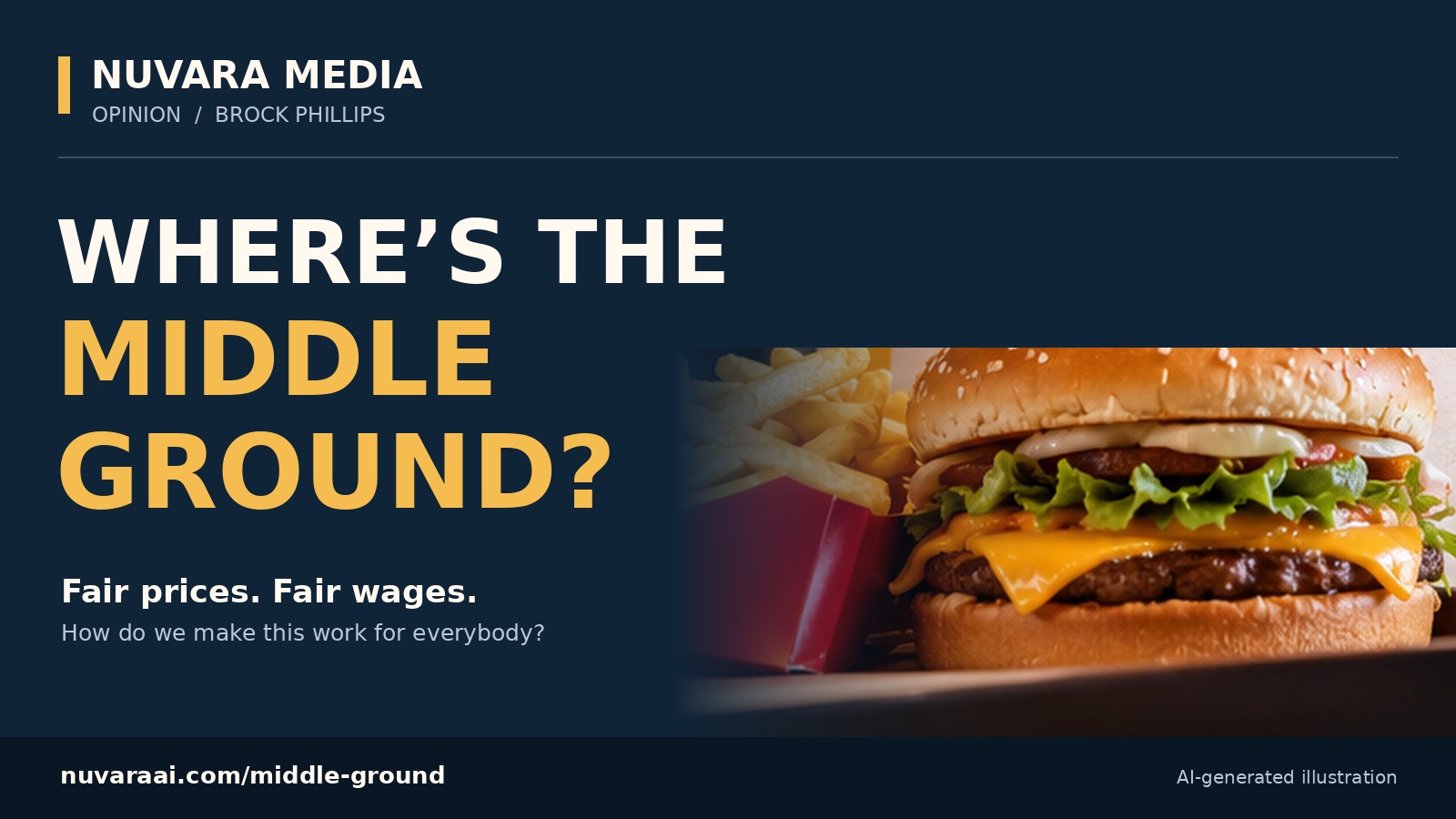
If a restaurant can sell me a hamburger, fries and a drink for one price at lunch, why should that exact same meal cost more at dinner?
Calling it a “lunch special” does not answer my question. Why can’t the lower price just be the price?
That bothers me even when the prices are clearly posted. But this conversation goes beyond lunch menus. It reaches into what companies know about us, how they decide what to charge, and how much of our paycheck it takes to buy the things we need.
What the facts say
Not every price change works the same way. Dynamic pricing adjusts prices based on conditions such as demand. Personalized pricing uses information about shoppers to determine prices or discounts. A digital shelf label is a display, not proof that either practice is happening. [1] [3]
The concern about personal information is real. In January 2025, the Federal Trade Commission reported that pricing companies could use information such as location, browsing history and shopping behavior to tailor prices and promotions. The companies examined served clients that included grocery and clothing retailers. [1]
A Walmart patent describes prices that could change based on what a customer has already scanned into a cart. One example involves offering a different price for mayonnaise when the shopper has tuna. “Different” does not necessarily mean higher, and a patent does not prove the system is being used. [2]
Walmart says it does not and will not use customers’ personal information to set individual prices. It also says it will not use digital shelf labels for personalized or dynamic pricing. That response belongs in the story alongside the patent. [3]
Then there is the Shake Shack video that caught my attention. A customer reported that milkshake prices increased after he selected “no tip” at an airport kiosk. Shake Shack says its operator traced the problem to a technology error unrelated to tipping and fixed it. The video alone does not establish that refusing a tip caused the increase. [4] [5]
I want unexpected charges explained. But I’m not going to call something a no-tip penalty when we haven’t established that it was one.
What about the billions in profit?
I also had to correct my own assumption about McDonald’s. It does not own the entire chain from cattle to customer. The company and its franchisees buy from independent suppliers, and about 95 percent of its restaurants were franchised at the end of 2025. [6]
McDonald’s reported $8.563 billion in worldwide profit for 2025, after its reported income-tax expense. That was not U.S. profit alone, and it was not money sitting in every local restaurant owner’s account. [6]
Costs and profits can rise at the same time. If a business brings in enough additional money to cover its higher expenses and still has more left over, both have increased.
I understand the math. My question is about the choices.
When a corporation makes billions, how much room is there to improve pay, lower prices, or both? What would that actually cost? I want to see the numbers, not assume that every business has the same answer.
Fair to whom?
I’ve raised the idea of taxing annual U.S. corporate profits above $2 billion at 50 percent. But I don’t know whether that would make food more affordable or improve workers’ pay. I’m not presenting it as a proven solution.
What I do know is what I want us to work toward.
Customers need fair prices. Workers need fair wages. Businesses should be able to make money.
I’m not asking for a cheaper hamburger at the expense of the person cooking it. I’m asking how that person earns a decent living while the family buying dinner can still afford to eat.
That is the conversation we want to have at Nuvara Media. Customers, workers and business owners all have something to contribute. Tell us what you’re paying, what you’re earning, or what it costs to keep your doors open. Explain what would need to change.
We don’t have to pretend we already agree. We do have to check the facts, including the ones that challenge our own opinions.
How do we make this work for everybody? Where’s the middle ground?